The current article updates the MiMo article on the case, published in 2023.
The FUEN Resolutions in Support of the Meskhetian Turks from Georgia
The Federal Union of European Nationalities (FUEN) is the largest umbrella organisation representing the interests of autochthonous, national and linguistic minorities in Europe. Founded in 1949, it brings together more than 100 member organisations and works to protect minority identities, languages, cultures and rights and to promote their effective participation in public life.
An important instrument in FUEN’s advocacy is the adoption of resolutions submitted by its member organisations. Through these resolutions, minority communities bring their concerns to the attention of national governments and European and international institutions, while proposing concrete measures to address existing problems.
The International/Interregional Society of Meskhetian Turks “Vatan” has repeatedly used this mechanism to draw attention to the unresolved consequences of the 1944 deportation of the Meskhetian Turks from southern Georgia. FUEN’s involvement in the case goes back considerably further: the 2016 resolution recalls that resolutions had been adopted since 1995 and that FUEN delegations had visited the region and discussed repatriation with the Georgian authorities.[1]
The resolutions available for the present review reflect a continuous line of advocacy concerning:
- 2016 – the failure to implement Georgia’s Council of Europe commitment on repatriation; shortcomings of the 2007 repatriation law; the need for realistic procedures, rehabilitation and removal of discriminatory restrictions.[2]
- 2019 – the continuing lack of effective return; a specific demand for simplified acquisition of Georgian citizenship by deportees and their descendants; and increasing linkage of the case with Georgia’s European aspirations.[3]
- 2022 – the continued failure of practical repatriation despite the existing legislation; lack of dialogue with Vatan; and reference to the Copenhagen criteria and the role of European institutions[4]
- 2023 – ineffective implementation of the repatriation framework; demand for realistic procedures and restoration of the rights of the deported population; and concern over the refusal of entry into Georgia to Vatan representatives and other Meskhetian activists.[5]
- 2025 – absence of progress since 2023; renewed demands concerning return and citizenship, accompanied by stronger emphasis on the social and economic conditions for sustainable return, international assistance and the continued exclusion of Meskhetian organisations from dialogue.[6]
The central demand throughout remains the effective return of the deported population and their descendants to their historical homeland. Later resolutions increasingly address the conditions required to make such a return viable, rather than merely legally possible.
The Unfinished Return
The history of the Meskhetian Turks and the development and shortcomings of Georgia’s repatriation policy are presented in detail in the Minority Monitor article “Meskhetian Turks: Would the Historical Justice be Ever Restored?”, published in 2023.[7]
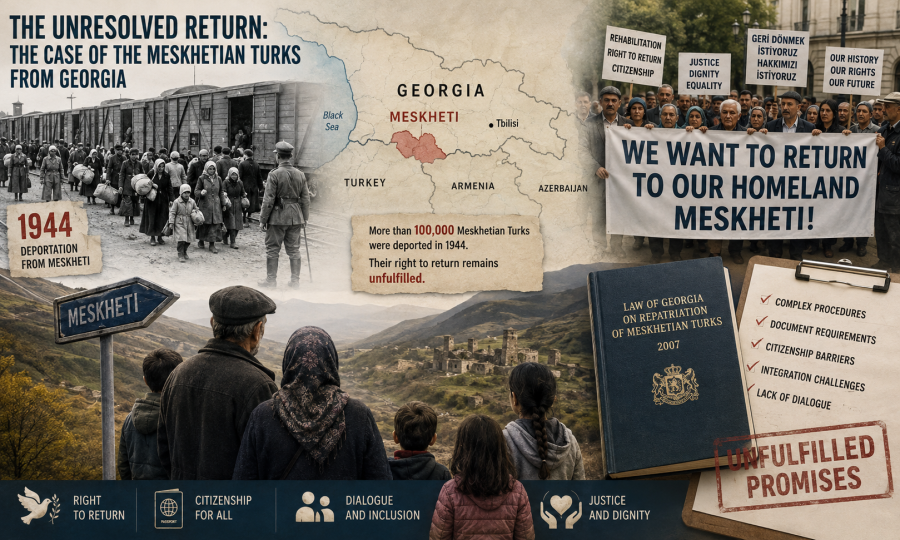
In brief, the Meskhetian Turks originate from the historical Meskheti region in present-day southern Georgia. In 1944, the Soviet authorities forcibly deported more than 100,000 people from the region to Central Asia. Return remained restricted throughout the Soviet period, while subsequent displacement – most notably following the violence in the Ferghana Valley in 1989 – left the community dispersed across several countries.[8]
When Georgia joined the Council of Europe in 1999, it undertook to establish a legal framework for repatriation and integration and to address the question of return within a defined period. Georgia eventually adopted a repatriation law in 2007, but its implementation produced very limited practical results. The 2023 Minority Monitor article identified the complexity of the application procedure, demanding documentary requirements, difficulties in accessing citizenship and rehabilitation, problems affecting the integration of returnees, and restrictions on the participation of Meskhetian organisations in the process as main obstacles.[9]
The Council of Europe has provided an important nuance to this assessment. Its 2022 monitoring concluded that Georgia had largely honoured the formal part of its accession commitment by establishing a legislative framework and repatriation strategy, while significant practical barriers continued to prevent effective repatriation (Council of Europe).[10]
The situation communicated through the subsequent FUEN resolutions indicates little substantive change. The 2025 resolution explicitly states that no progress has been made since the 2023 resolution and again raises questions about return, citizenship, integration, and the community's participation in the process.[11] The central issue therefore remains the gap between the existence of a repatriation framework and its ability to produce effective and sustainable return.
The Issues in Focus of the Resolutions
Effective repatriation
The central problem raised throughout the resolutions is the continuing gap between formal commitment and actual return. The 2023 Minority Monitor article examines in detail the weaknesses of the 2007 law, the application process, and the practical obstacles faced by potential returnees.[12]
The subsequent resolutions confirm the persistence of these problems. The 2016 resolution called for realistic procedures and removal of discriminatory restrictions; the 2019 and 2022 resolutions again argued that the existing framework had not resulted in effective return; and the 2023 resolution called for realistic procedures and restoration of the rights of the deported population. In 2025, FUEN stated directly that no progress had been achieved since its previous resolution. The current issue is therefore increasingly one of implementation rather than the absence of legislation.
Citizenship and rehabilitation
The 2023 Minority Monitor case also examined problems concerning citizenship and rehabilitation, including the limited results of the application process and difficulties in obtaining Georgian citizenship.[13]
The 2019 resolution called for a simplified citizenship procedure for those deported in 1944 and their descendants. The latest resolution maintains this demand, calling for fair procedures to restore citizenship, compliant with international standards and without ethnic or religious discrimination. The claims thus continue to frame citizenship and rehabilitation not as ordinary immigration matters, but as part of the remedy for a population forcibly removed from its homeland.
Participation and dialogue
The exclusion of representatives of the Meskhetian community from dialogue with the Georgian authorities is another issue already documented in the 2023 Minority Monitor article. It describes several cases in which representatives of Vatan and other Meskhetian organisations were refused entry into Georgia, including in 2019 and 2023.[14]
This concern had already entered the FUEN resolutions in 2022, which referred to the absence of contacts with Vatan. The 2023 resolution argued that refusing entry to community representatives effectively interrupted negotiations on repatriation.
Importantly, the 2025 resolution reports that the problem continues, stating that representatives of Vatan and other Meskhetian organisations are still systematically denied entry into Georgia and linking this practice with the absence of meaningful dialogue on the repatriation question
Sustainable return and integration
Integration was already identified as a problem in the 2023 Minority Monitor article, particularly regarding legal status, housing, education, and employment for those who had returned independently.[15]
FUEN supports the minority calls on Georgia to ensure the social, economic and cultural integration of returning families, including access to housing, land, education and healthcare. This expands the understanding of repatriation beyond the legal possibility of crossing the border or acquiring a particular status. Return is sustainable only when people are also provided with realistic conditions to rebuild their lives. The 2025 resolution introduces another important element: a more concrete role for the international community. It calls on the EU and other international partners to provide financial, technical, and legal assistance for a sustainable repatriation process and encourages cooperation and monitoring through the UN, the Council of Europe, and the OSCE.
European integration
The connection between the Meskhetian question and Georgia’s European aspirations has gradually become a major element of the resolutions. The 2019 resolution already called on EU Member States to consider resolution of the case in the context of Georgia’s future European integration. The 2022 resolution referred specifically to the Copenhagen criteria on human rights and minority protection, while the 2023 resolution directly linked resolution of the Meskhetian question to Georgia’s EU accession aspirations.
The 2025 resolution builds on this argument, presenting progress on the Meskhetian case as an indicator of Georgia’s adherence to European values and accession standards. This comes at a time when Georgia’s wider European integration process has itself become increasingly difficult. The European Commission’s 2025 assessment records a serious deterioration in Georgia’s accession trajectory and broader concerns regarding democracy, fundamental rights and the rule of law.[16] The Meskhetian question is thus increasingly presented not only as an unresolved historical issue, but also as a test of the practical implementation of human and minority rights standards associated with Georgia’s European orientation.
Moving from a Formal Return to a Workable Solution
The repeated adoption of resolutions on the same issue indicates the central problem. Georgia has established legislation and procedures on repatriation, but they have not produced returns on a scale that suggests the historical question has been effectively resolved. Vatan's continuing claims therefore concern less the creation of another formal mechanism than making the existing commitment practically accessible and capable of producing results.
A first step would be to review the repatriation and citizenship procedures with representatives of the Meskhetian community. Requirements developed for ordinary migration or naturalisation cannot necessarily respond adequately to the situation of people whose families were forcibly removed more than eighty years ago. Documentary requirements, citizenship rules and administrative procedures need to take account of this historical context while remaining transparent and legally predictable.
The second element concerns the conditions of return. The stronger emphasis placed on housing, land, education, healthcare and economic integration in the 2025 resolution is important. Repatriation cannot be sustainable if legal admission is not accompanied by realistic possibilities to establish a life in Georgia. Support for integration, including Georgian-language learning, must be combined with respect for the community's cultural identity and self-identification.
Restoring effective dialogue is equally important. Representatives of a dispersed community possess direct knowledge of the practical barriers faced by potential returnees and need to be involved in reviewing procedures and developing integration measures. The continued restrictions on the entry of community representatives reported in the FUEN resolutions work directly against this objective.
The international dimension can also be used more constructively. Georgia’s original commitment was made in the framework of its Council of Europe membership, while the EU, Council of Europe, OSCE, and UN have relevant expertise in minority protection, displacement, and integration. Their involvement can provide monitoring and political attention, as well as the technical and financial assistance required for a functioning repatriation programme.
Time has meanwhile become an additional obstacle. More than eighty years have passed since the deportation, and new generations have been born and established their lives far from their ancestral homeland. The objective can therefore no longer realistically be understood as returning an entire dispersed population. What can still be ensured is that those who wish to return are given a genuine, voluntary and viable opportunity to do so, while maintaining meaningful links between Georgia and the wider Meskhetian community. This would move the case beyond formal acknowledgement of a historical injustice towards providing a practical possibility for at least part of that injustice to be remedied.
References
[1] Federal Union of European Nationalities (FUEN) (2016) Resolution 2016-05: On the failure to fulfil the obligation imposed by the Council of Europe in relation to the repatriation back to their homeland of Meskhetian Turks who were deported in the Soviet Union in 1944. FUEN Assembly of Delegates, Wrocław/Breslau, 21 May 2016. Available at: https://fuen.org/assets/upload/editor/Resolutions_2016_EN.pdf
[2] ibidem
[3] Federal Union of European Nationalities (FUEN) (2019) Resolution 2019-07: Resolution on the Situation of the Meskhetian Turks. FUEN Assembly of Delegates, Bratislava/Pozsony/Pressburg, 15 June 2019. Available at: https://fuen.org/assets/upload/editor/docs/doc_kh9bLA0l_FUEN_Resolutions_2019_EN.pdf
[4] Federal Union of European Nationalities (FUEN) (2022) Resolution 2022-08: Resolution on the Return of the Meskhetian Turks to Georgia. FUEN Assembly of Delegates, Berlin, 1 October 2022. Available at: https://fuen.org/assets/upload/editor/docs/doc_m8FnA9r5_Resolutions_2022_EN_Q.pdf
[5] Federal Union of European Nationalities (FUEN) (2023) Resolution 2023-05: Resolution about the Accession of Georgia in the European Union (EU). FUEN Assembly of Delegates, Pécs/Fünfkirchen/Pečuh, 9 September 2023. Available at: https://fuen.org/assets/upload/editor/docs/doc_nR8MWabW_Resolutions%202023%20EN.pdf
[6][6] Federal Union of European Nationalities (FUEN) (2025) Resolution 2025-07: On the Return of the Meskhetian Turks and the Strengthening of Georgia’s European Integration. FUEN Assembly of Delegates, Bozen/Bulsan/Bolzano, 24 October 2025. Available at: https://fuen.org/assets/upload/editor/docs/doc_cI9yg1Yq_Resolutions%202025%20EN_dig.pdf
[7] Minority Monitor (2023) Meskhetian Turks: Would the Historical Justice be Ever Restored?, 5 September 2023. Available at: https://minoritymonitor.eu/en/article/Meskhetian-Turks-Would-the-Historical-Justice-be-Ever-Restored.Meskhetian Turks: Would the Historical Justice be Ever Restored?
[8] ibidem
[9] ibidem
[10] Parliamentary Assembly (PACE) (2022) The honouring of membership obligations to the Council of Europe by Georgia, Doc. 15497, 28 March 2022. Strasbourg: Council of Europe. Available at: https://pace.coe.int/en/files/29902/html
[11] Federal Union of European Nationalities (FUEN) (2025) Resolution 2025-07: On the Return of the Meskhetian Turks and the Strengthening of Georgia’s European Integration. FUEN Assembly of Delegates, Bozen/Bulsan/Bolzano, 24 October 2025. Available at: https://fuen.org/assets/upload/editor/docs/doc_cI9yg1Yq_Resolutions%202025%20EN_dig.pdf
[12] See note 7
[13] ibidem
[14] ibidem
[15] ibidem
[16] European Commission (2025) Georgia 2025 Report, SWD(2025) 757 final. Brussels: European Commission. Available at: https://enlargement.ec.europa.eu/document/download/7b6ed47c-ecde-41a2-99ea-41683dc2d1bd_en