The FUEN Resolutions in Support of the Breton Community in France
The Federal Union of European Nationalities (FUEN) is the largest umbrella organisation representing the interests of autochthonous, national and linguistic minorities in Europe. Founded in 1949, it brings together more than 100 member organisations from across Europe and works to protect minority identities, languages, cultures and rights and to promote their effective participation in public life.
An important instrument in FUEN’s advocacy is the adoption of resolutions submitted by its member organisations. Through these resolutions, minority communities bring specific concerns to the attention of national governments and European and international institutions, while proposing concrete measures to address existing problems.
The resolutions submitted by the Cultural Institute of Brittany (Institut culturel de Bretagne, ICB) to the FUEN project highlight community concerns related to preserving a historical territory and protecting the Breton language and cultural heritage. Respectively, the resolutions address the issues of:
- 2014 – the preservation of Brittany within its historical borders in the context of the French territorial reform and the demand for the reunification of Brittany rather than its incorporation into a larger administrative region.
- 2024 – the protection of historical Breton place names, considered an important element of the linguistic and cultural heritage of Brittany, against their disappearance or Frenchification in the implementation of the French 3DS Law and the standardisation of addressing. The Cultural Institute of Brittany (ICB) submitted the resolution.
- 2025 – the right of the population of Pays Nantais (Loire-Atlantique) to decide democratically whether the department should be reunited with the Brittany Region, following longstanding demands for a referendum on the issue.
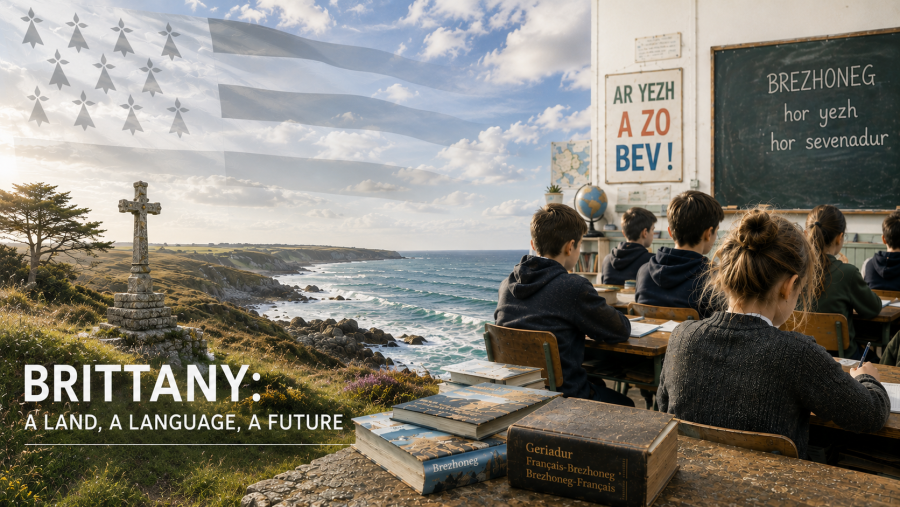
- 2025 – the protection and sustainable development of education in the Breton language, including adequate funding, teachers, premises and teaching materials, recognition of Breton-language qualifications and support for immersive education, with particular attention to the Diwan school network and Breton and Celtic studies at university level.
Two closely interconnected dimensions appear in the Breton case. The first concerns territory and the demand that Brittany's administrative borders correspond to what Breton organisations consider its historical territory. The second concerns preserving and transmitting the Breton language and cultural heritage. In both dimensions, the claims address how regional identity, language, and cultural distinctiveness can be effectively protected within the traditionally centralised French state model.
Historical Background and Present Status
The Bretons are a historical community concentrated in Brittany, in north-western France, with a distinctive territorial, cultural and linguistic identity. Breton belongs to the Celtic language family and has been present in the territory since the early Middle Ages. Brittany later developed into a distinct political territory and, later, the Duchy of Brittany, before its formal union with France in 1532.
Brittany retained a number of its particular institutions until the French Revolution, when the historical provincial structure was replaced by departments. The territory historically associated with Brittany corresponds to today's Finistère, Côtes-d'Armor, Morbihan, Ille-et-Vilaine and Loire-Atlantique. The progressive consolidation of the centralised French state was also accompanied by French dominance in administration, public institutions, and education, contributing to a significant decline in the intergenerational transmission and public use of Breton.
The position of regional languages gradually improved during the twentieth century. The Deixonne Law of 1951 permitted the teaching of several regional languages, including Breton, while the first Diwan class opened in 1977, introducing an immersive model of Breton-language education. Today Breton is taught through different educational models, including public and private bilingual streams and the Diwan network.[1]
The territorial question developed along a parallel path. In 1941, Loire-Inférieure – today's Loire-Atlantique – was separated for administrative purposes from the regional structure centred on Rennes. Subsequent arrangements maintained a four-department Brittany, while Loire-Atlantique, including Nantes, eventually became part of the Pays de la Loire Region. The separation has remained contested, and demands for reunification continue to this day.[2]
In 2018, approximately 105,000 people in Loire-Atlantique signed a petition requesting a consultation on reunification. More recently, both Région Bretagne and the Département de Loire-Atlantique have called on the French state to establish a referendum process and jointly commissioned an impact assessment of possible reunification.[3]
The status of the Breton language today similarly combines recognition with continuing vulnerability. Since 2008, Article 75-1 of the French Constitution has recognised regional languages as part of France's heritage, while Article 2 establishes French as the language of the Republic.[4] The Constitutional Council has clarified that Article 75-1 does not establish an enforceable constitutional right or freedom.[5] The 2021 Molac Law further strengthened the legislative recognition and promotion of regional languages, including in education.[6]
The Breton case is therefore not one of an absence of recognition. The central question is whether the existing legal and institutional support is sufficient to ensure the long-term transmission of the language and preservation of the territorial and cultural markers of Breton identity. These concerns are reflected in the FUEN resolutions concerning the historical territory of Brittany, Breton toponymy, and Breton-language education.
Preserving Historical Territory, Language, and Cultural Identity
The claims communicated through the FUEN resolutions concern different areas but share a common underlying concern: preserving the conditions necessary for the continuation of a distinct Breton identity. Territory, place names, and education are approached not simply as separate technical questions but as elements through which the community maintains its historical and linguistic continuity.
The historical territory and the reunification of Brittany
The territorial question is the earliest and most persistent issue appearing in the resolutions. The 2014 Urgent Resolution on Territorial Reform in Brittany was adopted in the context of the French Government's plans to substantially reduce the number of administrative regions. FUEN supported the objective of simplifying France's administrative structure but argued that this reform should not result in Brittany disappearing into or being amalgamated with a larger administrative entity. Instead, it called on France to commit to reunifying Brittany and restoring its historical borders.[7]
The claim concerns Loire-Atlantique and Nantes specifically. The historical relationship itself is well established: the official historical chronology published by Région Bretagne records the integration of Nantes and the Pays de Retz into Brittany in the ninth century and the administrative separation of Loire-Inférieure from the rest of Brittany in 1941.[8] Under the contemporary administrative structure, however, Loire-Atlantique belongs to Pays de la Loire. Breton organisations therefore present the issue as a discrepancy between the historical-cultural territory and the contemporary administrative territory.
The question reappears much more concretely in the 2025 resolution on the Right of the People of Pays Nantais (Loire-Atlantique) to Decide on Reunification with Brittany. The resolution recalls Loire-Atlantique's historical belonging to Brittany and describes its administrative separation as a decision taken without democratic consultation. It also refers to the petition signed by more than 105,000 citizens demanding a popular consultation and expresses concern that no referendum has been organised.[9]
The factual basis concerning the petition and the continuing demand for a referendum can be independently confirmed. The official 2024 impact study records the collection of 105,000 signatures in 2018.[10] It also records that both Région Bretagne and the Département de Loire-Atlantique have subsequently adopted positions calling for the state to enable a referendum process[11]. The 2025 claim is therefore somewhat different from the one made in 2014. While the earlier resolution directly advocates reunification, the later resolution places greater emphasis on the democratic right of the population concerned to decide the question. FUEN calls on the French Government to authorise a consultation of registered voters in Loire-Atlantique and on the Departmental Council to organise it transparently and impartially, with international observers, including FUEN and the Council of Europe, invited to monitor the process.
Thus, while reunification remains politically unresolved, the demand for a democratic consultation is no longer confined to minority or cultural organisations. It has also been formally advanced by the two principal territorial authorities directly concerned.
The disappearance of Breton place names
The 2024 resolution introduces a different but closely related dimension of protecting Breton identity: toponymy. Submitted by the Cultural Institute of Brittany (ICB), it addresses the effects attributed to implementing the French 3DS Law No. 2022-217 and the associated standardisation of addresses.[12]
According to the resolution, municipal implementation of the addressing requirements has in some cases resulted in previously unnamed roads receiving French names, French terms such as rue or chemin being combined with Breton names, or traditional locality names disappearing when addresses are standardised in the national database. The resolution cites examples from the area of Plouezoc'h and describes the cumulative effect as a gradual loss of Breton toponymy.
It is important here to distinguish between the content of the law and the effects alleged by the Breton organisations. The 3DS Law requires municipalities to name roads and localities and provide standardised address information; the conclusion that its implementation produces “debretonnisation” is the position advanced in the FUEN resolution, not an explicit purpose of the French legislation. The resolution itself provides the official Légifrance reference to the law.[13]
For the Breton organisations, the problem nevertheless extends beyond postal addressing. Traditional place names preserve information about the territory's language, history, landscape, and collective memory. Their disappearance can therefore progressively remove visible markers of Breton linguistic heritage from the landscape. The resolution links this concern to France's commitments under the UNESCO Convention for the Safeguarding of the Intangible Cultural Heritage.[14]
France is indeed a State Party to that Convention, having deposited its instrument on 11 July 2006. The Convention creates obligations to safeguard intangible cultural heritage identified within a state's territory and places particular importance on the role of communities in identifying and maintaining that heritage.[15]
FUEN consequently calls on France to reverse the effects attributed to the 3DS Law in the five Breton departments and supports Breton cultural organisations' efforts to protect Breton toponymy. The reference to five departments is significant, as the linguistic-heritage claim intersects with the territorial claim by including Loire-Atlantique within the cultural territory whose Breton heritage requires protection.
Breton-language education and intergenerational transmission
The second 2025 resolution focuses directly on transmitting the Breton language through education. It identifies a combination of problems concerning funding, recognition of qualifications, teacher shortages, premises and teaching materials, immersive education, and opportunities to take national examinations in Breton.[16]
The resolution places the Diwan school network at the centre of the solution. Established in 1977, Diwan provides immersive Breton-language education through a non-profit associative system. The resolution's historical date is independently confirmed by official French Ministry of Education documentation, which records the opening of Diwan's first nursery class in 1977.[17]
The position of immersive education has been particularly sensitive within the French constitutional system. The Constitutional Council's jurisprudence places considerable weight on Article 2 of the Constitution and on French as the language of the Republic. In earlier consideration of the possible integration of Diwan schools into public education, the Council emphasised that pupils in public educational establishments cannot be required to use a language other than French as the general language of teaching and institutional communication.[18]
The FUEN resolution draws particular attention to conditions at the Diwan secondary school in Carhaix. According to the resolution, funding problems and a lack of ownership of the premises have reduced space and created serious infrastructural deficiencies. It reports approximately 250 pupils accommodated in nine classrooms, shortages of teaching materials and problems with facilities including heating and water supply. Pupils have repeatedly protested against these conditions since the beginning of the 2024 school year. These details represent the situation as reported by the submitting organisation in the FUEN resolution.[19]
The concern extends beyond Diwan. The resolution also points to difficulties affecting Breton and Celtic studies at Rennes II and the University of Brest, particularly the non-renewal of teaching posts. It argues that weakening university-level teaching has wider implications because higher education provides the teachers and specialists required to sustain Breton-language education.
FUEN consequently calls on the French Republic to recognise and value qualifications in Breton, ensure access to minority-language education, and protect it from budget cuts. It also calls on the Brittany and Pays de la Loire regions to promote Breton in education and stop funding cuts.
These demands arise within a system in which Breton education is not prohibited. On the contrary, the Ministry of Education explicitly provides for regional-language education, including Breton, and current programmes exist at secondary-school level.[20] The issue raised by the resolution is therefore one of sustainability, extent and institutional security, rather than the complete absence of Breton from the education system.
One problem with different dimensions
The four resolutions address related problems. Territory, toponymy and education perform different functions in maintaining Breton identity. The territorial claim concerns the geographical space historically associated with that identity; the toponymy claim concerns the visibility of the Breton language and historical memory within that space; and the education claim concerns the transmission of language and identity to future generations.
The legal context makes the case particularly interesting. France recognises Breton as part of its national linguistic heritage and permits and financially supports various forms of Breton-language education. At the same time, Article 2 establishes French as the language of the Republic, Article 75-1 does not itself create an enforceable constitutional linguistic right, and France has not ratified the principal Council of Europe treaty devoted to regional and minority languages.[21]
The claims communicated through the FUEN resolutions can therefore be understood as demands to move from recognition of Breton identity and language as cultural heritage towards stronger practical conditions for their preservation and transmission. The underlying concern is that formal recognition alone does not necessarily prevent the gradual weakening of the territorial, linguistic and institutional foundations on which a historical community depends.
The Limited International Framework for Minority Protection in France
The claims raised in the FUEN resolutions also need to be considered against France's particular approach to minority protection. France does not recognise national minorities as distinct legal communities, relying instead on the constitutional principles of the indivisibility of the Republic, equality of citizens and unity of the French people. This approach has important consequences for its international commitments on minority and language rights.
Most importantly, France remains outside the two principal Council of Europe minority-protection instruments. It has neither signed nor ratified the Framework Convention for the Protection of National Minorities (FCNM).[22] France signed the European Charter for Regional or Minority Languages (ECRML) in 1999 but has never ratified it.[23] The Constitutional Council found elements of the Charter incompatible with constitutional principles concerning the indivisibility of the Republic, equality and the status of French as the language of the Republic.[24]
Breton consequently does not benefit from the binding commitments and international monitoring mechanisms provided by the FCNM and ECRML. France nevertheless protects and supports regional languages through domestic legislation and public policy, particularly in education and culture. The resulting system is therefore centred primarily on regional languages as cultural heritage rather than on recognising their speakers as national minorities with a specific body of minority rights.
Other international obligations remain relevant. France is a party to the International Covenant on Civil and Political Rights (ICCPR),[25] although it entered a declaration stating that Article 27 – which specifically protects the cultural, religious and linguistic rights of persons belonging to minorities – is not applicable to France in light of its constitutional framework.[26] France is also bound by the International Covenant on Economic, Social and Cultural Rights (ICESCR), including Article 15 on participation in cultural life.[27] UN monitoring therefore provides a broader basis for addressing the preservation and transmission of regional cultural and linguistic identities even in the absence of formal minority recognition.
The 2003 UNESCO Convention,[28] to which France is a party, is particularly relevant to the FUEN claim concerning Breton place names. It requires states to identify and safeguard intangible cultural heritage and recognises communities' role in maintaining and transmitting it. While it does not create minority-language rights comparable to the ECRML, it provides an international framework for protecting elements of linguistic and cultural heritage such as traditional toponymy.
Finally, the EU legal framework recognises minority rights and linguistic diversity as European values. Article 2 TEU refers to the rights of persons belonging to minorities, while Article 3 requires respect for Europe's cultural and linguistic diversity.[29] Articles 21 and 22 of the 2012 European Union Charter of Fundamental Rights respectively prohibit discrimination on grounds including language and membership of a national minority and require respect for cultural, religious and linguistic diversity.[30] Their application to domestic language policy is nevertheless limited by the scope of EU competences.
The Breton case highlights the important distinction between recognition and rights-based protection. France recognises and supports Breton as part of its cultural and linguistic heritage, but remains outside the European treaties specifically designed to protect national minorities and regional or minority languages.
The limitation of the French model stems from the fact that it recognises linguistic and cultural diversity primarily as heritage rather than as a matter of minority rights. The measures introduced by France provide space for the preservation and promotion of Breton, but their effectiveness depends on changing political priorities, institutional decisions, and available resources. The concerns raised through the FUEN resolutions suggest that cultural recognition alone does not necessarily secure the conditions required for a minority language and identity to remain viable. More consistent guarantees for Breton-language education, protection of the linguistic landscape and meaningful consideration of the territorial claims expressed by the population concerned would therefore strengthen the existing framework without challenging the constitutional unity of the French state. In this sense, the Breton case points to the possibility of reconciling the French republican model with stronger practical protection of its historical linguistic and cultural diversity.
References
[1] Ministère de l'Éducation nationale (n.d.) L'enseignement du breton. Paris: Ministère de l'Éducation nationale. Available at: https://www.education.gouv.fr/media/70018/download
[2] Région Bretagne / Conseil culturel de Bretagne (n.d.) Les liens historiques, culturels et linguistiques entre la Loire-Atlantique et la Bretagne. Rennes: Région Bretagne. Available at: https://www.bretagne.bzh/app/uploads/ccb_rapport_liens_culturels_44.pdf
[3] Région Bretagne (2024a) Rattachement du territoire du Département Loire-Atlantique au territoire de la Région Bretagne: Étude d'impact. Rapport final, 30 January 2024. Study commissioned jointly by Région Bretagne and Département de Loire-Atlantique. Available at: https://www.bretagne.bzh/app/uploads/Rattachement-Loire-Atlantique-Bretagne_Etude-dimpact_Rapport-final_30012024.pdf
[4] French Republic (1958) Constitution du 4 octobre 1958, particularly Articles 1, 2 and 75-1. Paris: Légifrance. Available at: https://www.legifrance.gouv.fr/loda/id/JORFTEXT000000571356
[5] Conseil constitutionnel (2011) Décision n° 2011-130 QPC du 20 mai 2011 – Mme Cécile L. et autres [Langues régionales]. Paris: Conseil constitutionnel. Available at: https://www.conseil-constitutionnel.fr/decision/2011/2011130QPC.htm
[6] French Republic (2021) Loi n° 2021-641 du 21 mai 2021 relative à la protection patrimoniale des langues régionales et à leur promotion [Molac Law]. Journal officiel de la République française, 23 May 2021. Available at: https://www.legifrance.gouv.fr/jorf/id/JORFTEXT000043524722
[7] Federal Union of European Nationalities (FUEN) (2014) Urgent Resolution on Territorial Reform in Brittany. Adopted by the FUEN Assembly of Delegates, Flensburg, Germany, 10 May 2014. Available at: https://fuen.org/user_upload/congress_2015/fueorg_fueorg_taetigkeitsbericht_090515-en-web.pdf
[8] Région Bretagne / Conseil culturel de Bretagne (n.d.) Les liens historiques, culturels et linguistiques entre la Loire-Atlantique et la Bretagne. Rennes: Région Bretagne. Available at: https://www.bretagne.bzh/app/uploads/ccb_rapport_liens_culturels_44.pdf
[9] Federal Union of European Nationalities (FUEN) (2025a) Resolution 2025-04: Right of the People of Pays Nantais (Loire-Atlantique) to Decide on Reunification with Brittany. Adopted by the FUEN Assembly of Delegates, Bozen/Bulsan/Bolzano, South Tyrol, Italy, 24 October 2025. Available at: https://fuen.org/assets/upload/editor/docs/doc_cI9yg1Yq_Resolutions%202025%20EN_dig.pdf
[10] Région Bretagne (2024a) Rattachement du territoire du Département Loire-Atlantique au territoire de la Région Bretagne: Étude d'impact. Rapport final, 30 January 2024. Study commissioned jointly by Région Bretagne and Département de Loire-Atlantique. Available at: https://www.bretagne.bzh/app/uploads/Rattachement-Loire-Atlantique-Bretagne_Etude-dimpact_Rapport-final_30012024.pdf
[11] Région Bretagne (2024b) La Région Bretagne et le Département de Loire-Atlantique appellent l'État à organiser un référendum décisionnel. Rennes: Région Bretagne. Available at: https://www.bretagne.bzh/actualites/la-region-bretagne-et-le-departement-de-loire-atlantique-appellent-letat-a-organiser-un-referendum-decisionnel/
[12] Federal Union of European Nationalities (FUEN) (2024) Resolution 2024-02: Endangered Place Names in Brittany (France), submitted by the Cultural Institute of Brittany (ICB). Adopted by the FUEN Assembly of Delegates, Husum/Hüsem, Germany, 21 September 2024. Available at: https://fuen.org/assets/upload/editor/docs/doc_8MG7UcnE_Resolutions%202024%20EN.pdf
[13] French Republic (2022) Loi n° 2022-217 du 21 février 2022 relative à la différenciation, la décentralisation, la déconcentration et portant diverses mesures de simplification de l'action publique locale (3DS), particularly Article 169. Journal officiel de la République française, 22 February 2022. Available at: https://www.legifrance.gouv.fr/eli/loi/2022/2/21/2022-217/jo/texte
[14] UNESCO (2003) Convention for the Safeguarding of the Intangible Cultural Heritage. Paris: UNESCO. Available at: https://ich.unesco.org/en/convention
[15] UNESCO (n.d.) France – Conventions. Paris: UNESCO. Official record of France's participation in UNESCO conventions, including the 2003 Convention for the Safeguarding of the Intangible Cultural Heritage. Available at: https://www.unesco.org/en/countries/fr/conventions
[16] Federal Union of European Nationalities (FUEN) (2025b) Resolution 2025-05: Support on the Education in Breton. Adopted by the FUEN Assembly of Delegates, Bozen/Bulsan/Bolzano, South Tyrol, Italy, 24 October 2025. Available at: https://fuen.org/assets/upload/editor/docs/doc_cI9yg1Yq_Resolutions%202025%20EN_dig.pdf
[17] Ministère de l'Éducation nationale (n.d.) L'enseignement du breton. Paris: Ministère de l'Éducation nationale. Available at: https://www.education.gouv.fr/media/70018/download
[18] Conseil constitutionnel (2001) Décision n° 2001-456 DC du 27 décembre 2001 – Loi de finances pour 2002. Paris: Conseil constitutionnel. Relevant to the constitutional considerations concerning the proposed integration of Diwan schools into public education. Available at: https://www.conseil-constitutionnel.fr/decision/2001/2001456DC.htm
[19] Federal Union of European Nationalities (FUEN) (2025b) Resolution 2025-05: Support on the Education in Breton. Adopted by the FUEN Assembly of Delegates, Bozen/Bulsan/Bolzano, South Tyrol, Italy, 24 October 2025. Available at: https://fuen.org/assets/upload/editor/docs/doc_cI9yg1Yq_Resolutions%202025%20EN_dig.pdf
[20] Ministère de l'Éducation nationale (n.d.) L'enseignement du breton. Paris: Ministère de l'Éducation nationale. Available at: https://www.education.gouv.fr/media/70018/download
[21] French Republic (1958) Constitution du 4 octobre 1958, particularly Articles 1, 2 and 75-1. Paris: Légifrance. Available at: https://www.legifrance.gouv.fr/loda/id/JORFTEXT000000571356
[22] Council of Europe (2026b) Chart of Signatures and Ratifications of Treaty 157: Framework Convention for the Protection of National Minorities. Strasbourg: Council of Europe Treaty Office. Available at: https://www.coe.int/en/web/conventions/full-list?module=signatures-by-treaty&treatynum=157
[23] Council of Europe (2026a) Chart of Signatures and Ratifications of Treaty 148: European Charter for Regional or Minority Languages. Strasbourg: Council of Europe Treaty Office. Available at: https://www.coe.int/en/web/conventions/full-list?module=signatures-by-treaty&treatynum=148
[24] Conseil constitutionnel (1999) Décision n° 99-412 DC du 15 juin 1999 – Charte européenne des langues régionales ou minoritaires. Paris: Conseil constitutionnel. Available at: https://www.conseil-constitutionnel.fr/decision/1999/99412DC.htm
[25] United Nations (1966a) International Covenant on Civil and Political Rights, adopted 16 December 1966, particularly Article 27. New York: United Nations. Available at: https://www.ohchr.org/en/instruments-mechanisms/instruments/international-covenant-civil-and-political-rights
[26] United Nations (n.d.) Declarations and Reservations: International Covenant on Civil and Political Rights – France. United Nations Treaty Collection. Available at: https://treaties.un.org/pages/ViewDetails.aspx?src=TREATY&mtdsg_no=IV-4&chapter=4&clang=_en
[27] United Nations (1966b) International Covenant on Economic, Social and Cultural Rights, adopted 16 December 1966, particularly Article 15. New York: United Nations. Available at: https://www.ohchr.org/en/instruments-mechanisms/instruments/international-covenant-economic-social-and-cultural-rights
[28] UNESCO (2003) Convention for the Safeguarding of the Intangible Cultural Heritage Paris: UNESCO. Available at: https://ich.unesco.org/en/convention
[29][29] European Union (2016a) Consolidated Version of the Treaty on European Union, OJ C 202, 7 June 2016, pp. 13–45, particularly Articles 2 and 3. Luxembourg: Publications Office of the European Union. Available at: https://eur-lex.europa.eu/legal-content/EN/TXT/?uri=CELEX:12016M/TXT
[30] European Union (2012) Charter of Fundamental Rights of the European Union, OJ C 326, 26 October 2012, pp. 391–407, particularly Articles 21, 22 and 51. Luxembourg: Publications Office of the European Union. Available at: https://eur-lex.europa.eu/legal-content/EN/TXT/?uri=CELEX:12012P/TXT