The article presents issues and perspectives from the 7th Annual FUEN Working Group Education Meeting (Komotini, 2025). It introduces contested narratives and viewpoints to outline the complexity of the situation.
Education-related challenges facing the Turkish minority in Greece were the focus of the 7th Annual Meeting of the FUEN Working Group Education, held in Komotini in November 2025. The meeting brought together representatives of national minorities, education experts, and civil society actors to exchange experiences and highlight structural and policy issues shaping minority education across Europe.
In light of minority schooling in Western Thrace, participants examined recent administrative measures, long-term trends affecting the Turkish minority school network, access to education at different levels, and the broader relationship between education, language, identity, and minority status. Together, these themes illustrated how education remains a key arena where minority rights and state policy intersect.
Beyond central educational questions, speakers pointed to the broader legal and institutional framework in which these debates unfold. Greece has neither signed nor ratified the Council of Europe Framework Convention for the Protection of National Minorities nor the European Charter for Regional or Minority Languages, two key Council of Europe instruments for minority protection and language rights. While this absence was noted, it does not remove Greece from international scrutiny or legitimate debate. Minority rights in Greece remain grounded in binding international obligations, including the Treaty of Lausanne (1923), the European Convention on Human Rights, relevant United Nations treaties, and standards developed within the OSCE and the Council of Europe.
Within this framework, organisations such as FUEN and minority representatives maintain a recognised role in raising concerns, exchanging experiences, and engaging in dialogue on education, language, and minority protection—placing national practices within broader European and international contexts.
Background: The Turkish Community in Greece and Their Minority Status
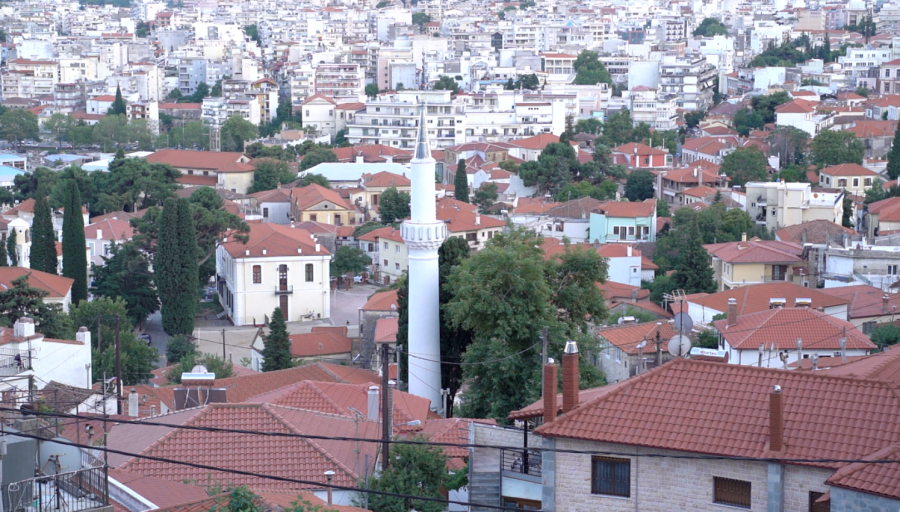
The Turkish community in Greece is part of the Muslim minority of Western Thrace, whose status is defined by the Treaty of Lausanne (1923). Officially, Greece recognises this minority on a religious basis rather than ethnic or linguistic lines. As documented in earlier Minority Monitor reporting, this approach has long caused tension. Many community members identify as Turkish, others as Pomak or Roma, yet all are collectively categorised as “Muslim” in official policy and administration.
This framework significantly impacts the educational situation of the minorities. Language of instruction, cultural representation, and institutional arrangements are closely tied to how minority status is interpreted. The absence of formal ethnic recognition continues to influence debates over education policy, data collection, and the framing of minority rights in Western Thrace. It also contributes to internal differentiation within the Turkish community, especially between Western Thrace and other regions of Greece.
Debates concerning minority education in Greece rarely involve community representatives, and little attention is paid to the differing experiences of minority groups labelled as “Muslim” and their specific challenges. This narrow framing limits discussion and makes it harder to situate Turkish minority education within a broader national and comparative minority education landscape. Greater engagement with comparative minority cases could lead to deeper analysis and more effective reflection on policy and practice.
General Educational Situation of the Turkish Minority
Institutionally, minority education in Western Thrace operates as a bilingual system within Greece’s national education framework. Minority primary schools provide instruction in both Greek and Turkish, with subjects divided between the two languages. Within the official curriculum framework, History, Geography, Greek language, environmental studies, and civics are taught in Greek, while Religious Education, Mathematics, Turkish language, Natural History/Science, arts, and music are taught in Turkish.
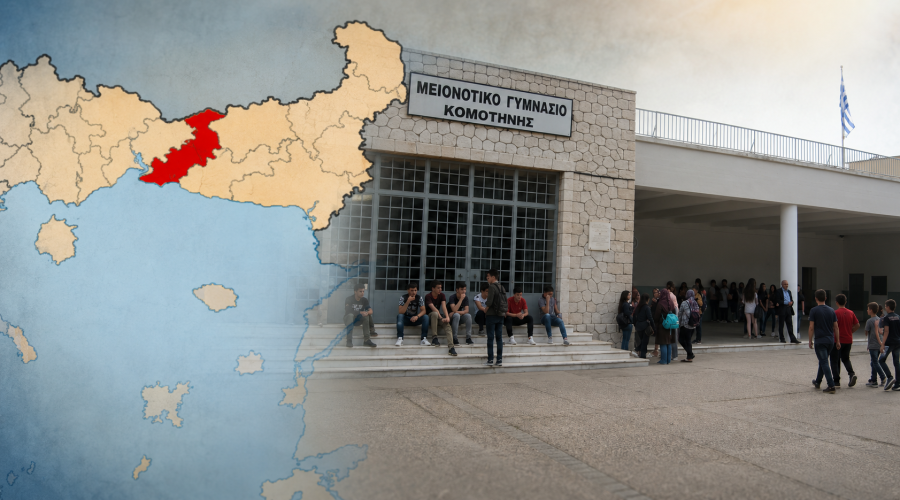
At the secondary level, minority education is much more limited. Only two minority secondary/high schools operate, in Komotini and Xanthi. Admission is limited by capacity, with lottery-based intake and reference figures of 60 and 30 available places. Access to higher education is facilitated through a 0.5% university entrance quota for members of the Muslim minority of Thrace, established under Law 2341/1995 and subsequent regulations.
In official and international documentation, data on the minority school network is usually presented as periodic snapshots rather than continuous monitoring. Greek state reporting lists 198 minority primary schools in 2007–2008, while submissions to the UN Committee on the Elimination of Racial Discrimination list 115 minority elementary schools with 4,103 students.
Access beyond primary education remains a central issue. Although the bilingual model at the primary level is clearly defined, the limited number of minority secondary schools creates structural bottlenecks. Lottery-based admission procedures are widely seen as introducing uncertainty for families seeking continuity in minority education.
Pre-primary education is another area of concern. Greece introduced two-year compulsory pre-primary education starting at age four under Law 4521/2018, building on earlier legislation that made attendance at age five compulsory from 2007–2008. Minority families experience these reforms unevenly, especially regarding availability and language profile of pre-primary provision in areas with high minority populations. Bilingual minority kindergartens are not permitted.
Teacher supply and training are shaped by differing institutional and community perspectives. Official frameworks acknowledge bilateral arrangements, including Turkish nationals serving as teachers in minority schools. From a community perspective, greater emphasis is placed on quota-based staffing and on fluctuations in teacher numbers, including an increase to 16 teachers in 2015–2016, which is seen as relevant to staffing continuity.
Access to higher education remains sensitive. While the 0.5% university quota is firmly established in law, outcomes over time are variable, with examples such as 67 students entering university in 1996–1997.
Governance, Administration, and Centralisation
From the perspective of the Turkish minority community, bilateral Greek–Turkish arrangements are a central reference point for minority education. The 1951 Cultural Agreement and the 1968 Cultural Protocol are key instruments that shape textbook provision, teacher placement, and educational cooperation. Official institutions acknowledge these agreements, but publicly accessible information on their implementation is limited. This gap leads to parallel interpretations of how bilateral arrangements function in practice.
Administrative practices affecting minority schools are another concern. Schools may be subject to “suspension of operation” (αναστολή λειτουργίας), including decisions affecting Eastern Macedonia and Thrace for the 2025–2026 period. Minority communities see such suspensions, combined with demographic change, as having potential long-term effects on access to minority education and the sustainability of the school network.
From a community perspective, these developments are linked to a highly centralised education system. Decisions on school operations, staffing, and administration are made mainly at higher levels, leaving little room for local participation. This contrasts with historical views of minority education involving more self-management.
In this governance context, the role of school committees and parent councils is interpreted differently. Although these bodies formally exist, minority parents and community members see them as having limited practical influence. Decision-making is widely seen as insufficiently responsive to parental input, creating a sense of distance from educational governance. Professional appointments illustrate these dynamics in practice. Within the existing governance framework, the nomination and appointment of directors in minority secondary schools have generated sustained contention. From the perspective of school committees, appointment procedures and outcomes are viewed as insufficiently responsive to local input. At the same time, institutional responses rejecting objections are interpreted as reinforcing the limited practical influence of local governance structures.
Limitations on direct access to minority schools further shape perceptions of governance and transparency. The lack of opportunities for external observation of daily school functioning reflects broader challenges with openness, transparency, and sustained dialogue about minority education. Minority education is understood, from the perspective of the Turkish minority community in Western Thrace, as having an autonomous and special character rooted in minority protections under the Treaty of Lausanne, particularly Article 40. Within this interpretative framework, long-term developments are viewed as reflecting a sustained contraction of the minority primary school network, with reference to 307 schools in 1926 and a progressive decline in recent years to 115 schools in 2020–2021, 90 in 2023–2024, 86 in 2024–2025, and 83 in 2025–2026, including regional distributions by prefecture.
Some earlier figures match official reports, but later data comes mainly from community-level monitoring. These developments indicate sustained structural pressure on minority education, especially in rural areas.
A Distinct and More Restrictive Situation in the Dodecanese Islands
The educational situation of the Turkish community in Greece cannot be understood solely in terms of developments in Western Thrace. In the Dodecanese Islands—particularly Rhodes and Kos—the situation follows a distinct and considerably more restrictive pattern.
According to the legal position applied by Greek public authorities, the Treaty of Lausanne does not extend to the Dodecanese Islands, which were under Italian administration in 1923 and were transferred to Greece only in 1947 under the Treaty of Paris. Within this framework, the Turkish population of Rhodes and Kos is not recognised as a minority, but is classified as Greek citizens of Muslim faith. In contrast to the situation in Western Thrace, the Turkish community is deprived not only of ethnic recognition but also of its linguistic rights. This legal interpretation has direct and far-reaching consequences for education.
Historically, Turkish-language education existed on the islands from 1912 to 1972. Throughout the Italian period, the German occupation, the British administration, and the early years of the post-war Greek state, the community maintained primary and secondary schools that offered Turkish-language education, including bilingual Turkish–Greek instruction. From the early 1970s onwards, however, this educational framework was progressively dismantled. Turkish-language instruction was discontinued before the 1971–1972 school year; religious education was abolished in 1973; Turkish teachers were dismissed or retired; and all Turkish schools in the Dodecanese were closed. Since that period, no public Turkish-language or bilingual education has been re-established.
At present, the Turkish community in the Dodecanese has no access to minority schools, mother-tongue instruction, or bilingual education within the public system. Children attend mainstream Greek public schools where instruction is delivered exclusively in Greek, while teaching of Turkish language or culture takes place only through informal, non-recognised community initiatives. Within an analytical perspective, this situation illustrates how the absence of minority recognition corresponds to the exclusion of minority language education from the public education system.
Educational Situation of the Pomak and the Macedonian Minorities
It is worth mentioning that the educational situation of other minority groups in Greece reflects similarly differentiated patterns shaped by legal status and recognition. In Western Thrace, particular attention is directed to the Pomak population, whose members are predominantly Greek-speaking. Hence, from the point of view articulated within Pomak public discourse, the increasing influence of Turkish language and identity markers in education is of concern, as are the perceived implications for identity formation among Pomak children. These dynamics illustrate the internal diversity encompassed by the officially recognised “Muslim minority” and demonstrate how education policies affect different communities in distinct ways.
The situation of the Macedonian minority follows a different trajectory. Within the institutional framework applied by Greek authorities, a Macedonian national minority is not recognised. As a result, language-related educational needs are addressed primarily through non-state or informal initiatives. This produces a distinct pattern in which minority language education exists largely outside the public education system.
Taken together with the situation in the Dodecanese Islands, these cases point to sharply differentiated minority education regimes in Greece, shaped by legal recognition, historical arrangements, and institutional interpretation.
Conclusion: Toward Inclusive and Evidence-Based Dialogue
Within a broader analytical assessment, the situation of minority education in Greece highlights the importance of inclusive, transparent, and evidence-based dialogue. Situating Turkish minority education within a wider European context and engaging systematically with the experiences of other minority groups emerge as relevant analytical approaches.
Beyond legal frameworks and administrative arrangements, a structural challenge concerns the limited degree of cooperation among minority groups within Greece. Fragmentation of minority voices, differing priorities, and the absence of sustained cross-minority coordination reduce collective visibility in national debates. While distinct historical and legal circumstances shape minority communities, limited coordination risks reinforcing isolation and constraining their capacity to influence education policy.
At the same time, restricted engagement with comparative minority education experiences limits opportunities for broader reflection. Comparative examples from other European contexts illustrate how minority education may benefit from decentralised governance, institutional support, and sustained investment in teacher training and educational materials. Strengthening comparative exchange within platforms such as the FUEN Working Group offers a pathway for broader perspective-building and informed reflection on the future development of minority education in Greece.
References:
Council of Europe. European Charter for Regional or Minority Languages (ECRML), 1992.
https://www.coe.int/en/web/european-charter-regional-or-minority-languages
Council of Europe. European Convention on Human Rights (ECHR), 1950.
https://www.echr.coe.int/european-convention-on-human-rights
Council of Europe. European Commission against Racism and Intolerance (ECRI). Country Monitoring Reports on Greece, ongoing (first cycle 1998)
https://www.coe.int/en/web/european-commission-against-racism-and-intolerance/greece
Council of Europe. Framework Convention for the Protection of National Minorities (FCNM), 1995.
https://www.coe.int/en/web/minorities
https://www.coe.int/en/web/minorities
Directorate of Primary Education of Rodopi (Greece). Minority Primary Education: Curriculum and Language Allocation
https://dipe.rod.sch.gr
https://dipe.rod.sch.gr
European Commission / Eurydice. Greece: Overview of the Education System and Minority Education, ongoing.
https://eurydice.eacea.ec.europa.eu/national-education-systems/greece
https://eurydice.eacea.ec.europa.eu/national-education-systems/greece
Federal Union of European Nationalities (FUEN). Working Group Education – 7th Annual Meeting, Komotini, 2025.
https://fuen.org
https://fuen.org
Hellenic Republic. Law 2341/1995 on special admission quotas to higher education for members of the Muslim minority of Thrace, 1995.
https://www.kodiko.gr/nomothesia/document/118209/nomos-2341-1995
https://www.kodiko.gr/nomothesia/document/118209/nomos-2341-1995
Hellenic Republic. Law 3518/2006 on compulsory pre-primary education (age 5), 2006.
https://www.kodiko.gr/nomothesia/document/73438/nomos-3518-2006
https://www.kodiko.gr/nomothesia/document/73438/nomos-3518-2006
Hellenic Republic. Law 4521/2018 introducing two-year compulsory pre-primary education, 2018.
https://www.kodiko.gr/nomothesia/document/396007/nomos-4521-2018
https://www.kodiko.gr/nomothesia/document/396007/nomos-4521-2018
Hellenic Republic. Ministerial Decisions 62092/2002 (FEK B 776/2002) and 62094/2002 (FEK B 825/2002) on minority school boards (Σχολικές Εφορείες), 2002.
https://www.et.gr
Kathimerini English Edition (eKathimerini). Pomak leader warns of growing Turkish influence, 2023.
https://www.ekathimerini.com/news/1214051/pomak-leader-warns-of-growing-turkish-influence/
https://www.ekathimerini.com/news/1214051/pomak-leader-warns-of-growing-turkish-influence/
Organisation for Security and Co-operation in Europe (OSCE). Minority Rights and Education Standards (High Commissioner on National Minorities), ongoing (established 1992).
https://www.osce.org/hcnm
https://www.osce.org/hcnm
Treaty of Lausanne, Convention Concerning the Protection of Minorities, 1923.
https://treaties.un.org/doc/Publication/UNTS/LON/Volume%2028/v28.pdf
https://treaties.un.org/doc/Publication/UNTS/LON/Volume%2028/v28.pdf
United Nations. International Covenant on Civil and Political Rights (ICCPR), 1966.
https://www.ohchr.org/en/instruments-mechanisms/instruments/international-covenant-civil-and-political-rights
https://www.ohchr.org/en/instruments-mechanisms/instruments/international-covenant-civil-and-political-rights
United Nations Committee on the Elimination of Racial Discrimination (CERD). State Reports and Concluding Observations on Greece, ongoing (Greece ratified ICERD in 1970).
https://tbinternet.ohchr.org/_layouts/15/treatybodyexternal/Countries.aspx?CountryCode=GRC&Lang=EN
https://tbinternet.ohchr.org/_layouts/15/treatybodyexternal/Countries.aspx?CountryCode=GRC&Lang=EN