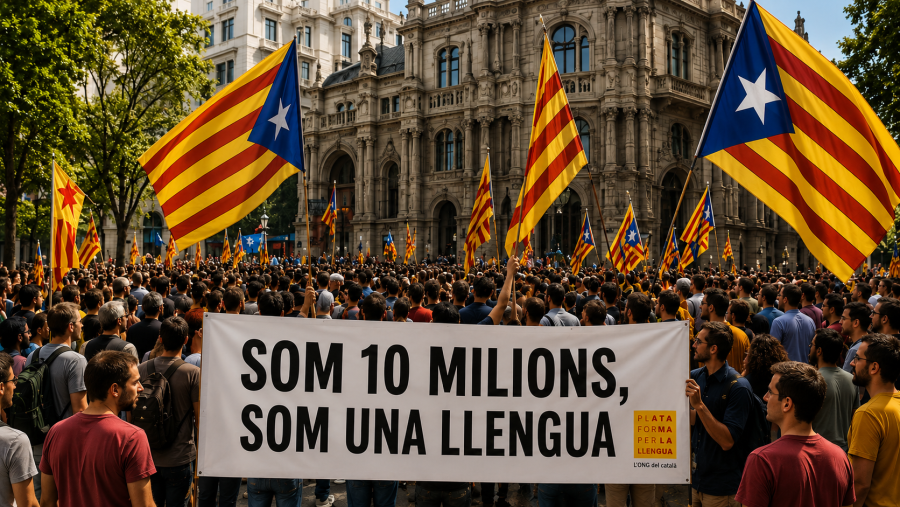
The Catalans and FUEN’s Commitment to Protecting Minority Rights
The Federal Union of European Nationalities (FUEN) is the largest umbrella organisation representing the interests of autochthonous, national, and linguistic minorities in Europe. Founded in 1949, it brings together more than 100 member organisations (MOs) from 36 European countries and actively works to defend rights and promote the cultural, linguistic, and political recognition of minority communities.
FUEN’s mission is not only to preserve Europe's diversity by protecting minority identities, but also to uphold international human rights standards and ensure minorities' inclusion in the political and social fabric of their respective states. In line with this, FUEN has consistently supported its member organisations by adopting targeted resolutions that address concrete violations of minority rights and call for recognition, equality, and protection from discrimination.
By providing a forum to elevate minority concerns to the attention of the Council of Europe, the EU, the UN, and national governments, FUEN reinforces the legitimacy and urgency of these claims. The case of the Catalan-speaking community in Spain provides a particularly interesting example of FUEN’s advocacy for linguistic and national minority rights, as it concerns a large historical European language community enjoying considerable autonomy and formal language rights at regional level, while continuing to face important challenges regarding recognition and the effective use of its language at state and European levels.
Since 2022, the FUEN Congress has adopted five resolutions proposed by its member organisation Plataforma per la Llengua. The resolutions address different aspects of the situation of Catalan speakers in Spain. The core demands across these resolutions include:
- Recognition of the Catalan-speaking community of Spain as a national and linguistic minority and its inclusion within the scope of protection of the FCNM.
- Effective protection and promotion of the Catalan language in public and private life, including public administration and services.
- Protection of Catalan as the principal language of the linguistic immersion model in education.
- Recognition of Catalan as an official language of the European Union.
- Effective linguistic equality in the justice system, including the right to use Catalan and adequate language competence among judicial personnel.
Taken together, these resolutions call for the recognition of the Catalan-speaking community and the effective protection of its linguistic rights in accordance with European and international standards, particularly the Council of Europe Framework Convention for the Protection of National Minorities (FCNM)[1] and the European Charter for Regional or Minority Languages (ECRML).[2]
Historical Background and Present Status
The Catalans are a Romance-language community whose historical territory developed in the north-eastern part of the Iberian Peninsula during the Middle Ages.[3] Medieval Catalonia formed part of the Crown of Aragon and developed its own political institutions, legal traditions and language. Catalan subsequently became established not only in present-day Catalonia but also, in different historical circumstances, in Valencia, the Balearic Islands and other territories around the western Mediterranean.
An important turning point came at the beginning of the eighteenth century. Following the War of the Spanish Succession and the fall of Barcelona in 1714, the Nueva Planta decrees abolished the principal institutions and legal structures of the territories of the former Crown of Aragon and strengthened political and administrative centralisation under the Spanish monarchy. Over the following centuries, Spain increasingly dominated state institutions and administration.
The nineteenth century nevertheless saw a significant cultural revival of Catalan, known as the Renaixença, accompanied later by growing political demands for regional autonomy and recognition of Catalan identity. At the beginning of the twentieth century, these demands became increasingly institutionalised, including efforts to introduce Catalan into education and public administration and to establish institutions supporting Catalan language and culture.
During the Second Spanish Republic, Catalonia regained some political autonomy. The Statute of Autonomy of 1932 restored the Generalitat and Catalan obtained official status. The Spanish Civil War and the establishment of the Franco dictatorship interrupted this development. Under Franco, Catalan was removed from state administration and education and its public use was severely restricted. The language survived predominantly through family transmission, cultural activity and private use.
Following Franco's death in 1975 and Spain's transition to democracy, the constitutional and institutional position of Catalan changed fundamentally. The 1978 Constitution recognised Spain's linguistic plurality and allowed languages other than Castilian to obtain official status under their respective Statutes of Autonomy. Catalan subsequently became co-official with Spanish in Catalonia and the Balearic Islands, while Valencian—the name used for the language in the Valencian Community—also acquired official status. Regional legislation introduced Catalan more systematically into education, public administration and the media.
Today, Catalonia enjoys extensive self-government through the Generalitat, the Parliament of Catalonia and other institutions established under its Statute of Autonomy. Competences exercised by the autonomous authorities include key areas for preserving Catalan identity, such as education, culture, and parts of public administration.[4] Nevertheless, territorial autonomy and co-official status do not eliminate concerns raised by Catalan organisations about effective equality between Catalan and Spanish.
Towards Linguistic Equality and Minority Status
The claims presented by Plataforma per la Llengua through the FUEN resolutions concern different aspects of linguistic equality, which appear affected by the official state policies.
The first resolution, adopted in 2022,[5] concerned the protection and promotion of the Catalan language. It highlighted Catalan's unequal position compared with Spanish, despite having more than ten million speakers and being co-official in Catalonia, the Balearic Islands and Valencia. The resolution referred to problems affecting the use of Catalan in the judiciary, education and universities, public administration and services and business life.
FUEN called for the official recognition of Catalan as a regional or minority language, the collection of reliable data on linguistic minorities and language use in Spain, and public policies with adequate budgets and measurable objectives to reverse the decline in the use of the country's native languages. It placed particular emphasis on normalising Catalan in public services, education, healthcare, the judiciary, security forces, and administration, including through language-proficiency requirements and training for public employees. The resolution also called for measures against linguistic discrimination and for Spain to fully comply with the FCNM and the ECRML.
The 2023 resolution[6] moved beyond protecting the language itself and addressed the recognition of Catalan speakers and other autochthonous language communities in Spain as national minorities. Plataforma per la Llengua challenged the position of the Spanish State that no national minorities exist in Spain and called for the Catalan-speaking minority to be included within the personal scope of application of the Framework Convention for the Protection of National Minorities.
The resolution called on Spain to recognise its national and linguistic minorities, include the Catalan-speaking minority as a group protected by the FCNM, establish a statistical monitoring instrument to assess language vitality, and conduct a comprehensive census of national and linguistic minorities, including questions on language use, preferences, and self-identification. It also called on the European Commission to reconsider its position on the Minority SafePack Initiative.
In 2024, two resolutions addressed more specific aspects of Catalan linguistic rights.[7] The first called for Catalan to become an official language of the European Union. The resolution pointed out that Catalan is the thirteenth most widely spoken language in the EU but does not enjoy the institutional recognition given to several European languages with considerably fewer speakers. Following the Spanish Government's request that Catalan and the other co-official languages of Spain be granted official EU status, FUEN called on the EU Member States to vote in favour of making Catalan an official language of the Union.
The second 2024 resolution[8] focused on linguistic immersion in the Catalan education system. Catalan has traditionally been the principal, although not exclusive, language of instruction in Catalonia, with the objective of ensuring that pupils leave compulsory education proficient in both Catalan and Spanish. Plataforma per la Llengua and FUEN considered the immersion model particularly important because Spanish occupies a considerably stronger position in society and children from Spanish-speaking backgrounds might otherwise have limited opportunities to acquire Catalan to the same level.
The resolution reacted to judicial decisions requiring at least 25 per cent of teaching to be conducted in Spanish in certain schools and classrooms. FUEN called on the European Parliament to safeguard minority linguistic rights, on the Spanish State to protect the successful immersion model, and on the Spanish judiciary to review and reconsider the ruling introducing the minimum percentage of Spanish-language instruction.
The most recent resolution, adopted in 2025,[9] concerns linguistic choice in the Spanish justice system. It argues that the existing legal framework establishes Spanish as the default language of judicial proceedings and makes the effective use of Catalan and other co-official languages conditional. It also identifies the lack of compulsory knowledge of Catalan among judges, prosecutors, and judicial officials working in Catalan-speaking territories as a major obstacle to linguistic equality.
FUEN called for amendments to Articles 231, 483 and 530 of the Organic Law of the Judiciary in order to normalise the use of co-official languages in the administration of justice, guarantee that citizens rather than judicial personnel determine the language they wish to use, and require adequate proficiency in the relevant co-official language from judicial personnel working in bilingual territories. The resolution also requested the competent Spanish judicial institutions to investigate infringements of linguistic rights and, where necessary, impose sanctions, while calling on the European Commission to examine the compatibility of the existing situation with international standards.
Thus, the five resolutions show a gradual development of the claims advanced by Plataforma per la Llengua: from the general protection of Catalan and the reversal of language decline, through recognition of Catalan speakers as a national and linguistic minority, to concrete institutional guarantees in education, justice, and the European Union.
Spain and its International Obligations to the Protection of National Minorities
Signed in 1995, the Council of Europe Framework Convention for the Protection of National Minorities (FCNM)[10] entered into force for Spain on 1 February 1998. The Convention provides for effective equality; protection of minority identity, language, culture, and traditions; and effective participation in cultural, social, and economic life and public affairs. However, its scope of application in Spain remains rather limited.
Since the ratification of the FCNM, Spain has consistently maintained that, under its constitutional system, no national minorities exist on its territory and in practice applies the Framework Convention to Spanish citizens belonging to the Roma community. The claims advanced by Plataforma per la Llengua are directly related to this official position. In response to the demands of representatives of the Catalan, Basque, and Galician language and cultural communities, communicated during monitoring visits, the Advisory Committee has stressed that the protection already provided by the Spanish Constitution, autonomous legislation, and the Language Charter has not made the additional protection offered by the FCNM unnecessary. It also underlined that enjoying minority rights does not depend on a community first being formally recognised in national law as a “national minority”.[11]
The latest Advisory Committee Opinion reiterates the general principle that formal recognition as a national minority is not a prerequisite for applying the Framework Convention and that its provisions can be applied on an article-by-article basis to groups that may benefit from minority protection.[12] This provides an important international-law context for Plataforma per la Llengua's 2023 demand that Catalan speakers be brought within the scope of protection of the FCNM.
The legal situation is different under the European Charter for Regional or Minority Languages (ECRML). Spain ratified the Charter in 2001, and it explicitly protects Catalan. In Catalonia, the Balearic Islands, and the Valencian Community, where the language is officially known as Valencian, Catalan benefits from the more extensive protection of Parts II and III of the Charter. Catalan varieties in other territories, including Aragon and Murcia, are also covered by the Charter, although the level of protection differs according to territory.[13]
The Charter places obligations on Spain in areas directly connected with the demands raised in the FUEN resolutions: education, judicial authorities, administrative authorities and public services, media, cultural activities, economic and social life and trans-frontier exchanges. Unlike the disputed question of national-minority recognition under the FCNM, Spain's international obligation to protect and promote Catalan as a regional or minority language is therefore firmly established.
Where Does the Problem Lie?
The Catalan-speaking community differs from many other minority cases in Europe. Catalan enjoys co-official status in Catalonia, the Balearic Islands and the Valencian Community, and is extensively used in education, regional and local administration, public media and cultural life. It also benefits from a comparatively strong legal and institutional framework. Nevertheless, despite the obligations undertaken to protect Catalan under the European Charter for Regional or Minority Languages (ECRML), Spain's legal guarantees have not eliminated implementation problems.
While the Spanish system of regional and minority-language protection is generally well developed, the Council of Europe's Committee of Experts has identified shortcomings, particularly in the justice system, healthcare, and state administration.[14] According to the Committee of Experts, existing legislation or its interpretation does not guarantee that criminal, civil, and administrative proceedings can be conducted in regional or minority languages when requested, and these languages remain rarely used before the courts. A related problem is the insufficient number of state officials with adequate knowledge of the relevant co-official language.
Education presents a somewhat different challenge. The Catalan linguistic immersion model has provided extensive education in Catalan while aiming to ensure proficiency in both Catalan and Spanish. However, judicial decisions requiring a minimum percentage of teaching in Castilian have created tension between this model and state-level decisions. Hence, although Catalan already enjoys substantial legal protection, the implementation of linguistic rights remains incomplete, particularly within institutions under state competence.
Claims for effective linguistic equality, however, represent one of two interconnected but distinct dimensions of the Catalan case. The second concerns minority recognition of the Catalan speakers as a historical national and linguistic minority benefiting from the wider protection provided by the FCNM.
While solutions to ensure the demanded linguistic equality can be found by addressing gaps in existing systems at national and regional levels, the broader question of recognition requires dialogue between the Spanish authorities and the Catalan-speaking community. Recognition under the Framework Convention and implementation of the Language Charter should therefore not be treated as alternatives. They address different aspects of the issue: the ECRML provides the main international framework for protecting and promoting the Catalan language, while the FCNM raises the broader question of protecting Catalan speakers as a community.
Seen from this perspective, the five FUEN resolutions adopted between 2022 and 2025 form a coherent sequence. They move from the general protection and promotion of Catalan, through the demand for minority recognition, to specific questions where effective equality remains contested: EU official status, education and the justice system. The central issue is therefore not the absence of Catalan-language rights in Spain, but the gap between formal recognition and their full practical implementation, combined with the still unresolved question of the status of Catalan speakers within Spain's system of national minority protection.
References
[1] Council of Europe (1992) European Charter for Regional or Minority Languages (ETS No. 148). Strasbourg: Council of Europe. Available at: https://www.coe.int/en/web/european-charter-regional-or-minority-languages/text-of-the-charter
[2] Council of Europe (1995) Framework Convention for the Protection of National Minorities (ETS No. 157). Strasbourg: Council of Europe. Available at: https://www.coe.int/en/web/minorities/basic-texts
[3]Generalitat de Catalunya (n.d.a) Origins and History of Catalan. Barcelona: Generalitat de Catalunya. Available at: https://llengua.gencat.cat/en/el-catala/origens-i-historia/
[4] Generalitat de Catalunya (n.d.b) Self-government. Barcelona: Generalitat de Catalunya. Available at: https://web.gencat.cat/en/generalitat/qui-som/autogovern
[5] Federal Union of European Nationalities (FUEN) (2022) Resolution 2022-03: Resolution on the Protection and Promotion of the Catalan Language, submitted by Pro-Language Platform Association (Plataforma per la Llengua). FUEN Assembly of Delegates, Berlin, 1 October 2022. Available at: https://fuen.org/en/article/Resolutions-2022
[6] Federal Union of European Nationalities (FUEN) (2023) Resolution 2023-01: Resolution on the Recognition of Catalan Speakers and the Other Autochthonous Language Communities in Spain as National Minorities and Their Inclusion in the Framework Convention for the Protection of National Minorities (FCNM), submitted by Plataforma per la Llengua. FUEN Assembly of Delegates, Pécs/Fünfkirchen/Pečuh, 9 September 2023. Available at: https://fuen.org/en/article/Resolutions-2023
[7] Federal Union of European Nationalities (FUEN) (2024a) Resolution 2024-05: Catalan – an Official EU Language, submitted by Association Plataforma per la Llengua. FUEN Assembly of Delegates, Husum/Hüsem, 21 September 2024. Available at: https://fuen.org/assets/upload/editor/docs/doc_L1fkNF8E_Resolution%202024-05_EN.pdf
[8] Federal Union of European Nationalities (FUEN) (2024) Resolution 2024-06: In Favor of the Immersive Education System in Catalonia, submitted by Association Plataforma per la Llengua. FUEN Assembly of Delegates, Husum/Hüsem, 21 September 2024. Available at: https://fuen.org/assets/upload/editor/docs/doc_ZZmeHCTc_Resolution%202024-06_EN.pdf
[9] Federal Union of European Nationalities (FUEN) (2025) Resolution 2025-02: Resolution on Linguistic Choice in the Spanish Justice System. FUEN Assembly of Delegates, Bozen/Bulsan/Bolzano, 24 October 2025. Available at: https://fuen.org/en/article/Resolutions-2025
[10] Council of Europe (1992) European Charter for Regional or Minority Languages (ETS No. 148). Strasbourg: Council of Europe. Available at: https://www.coe.int/en/web/european-charter-regional-or-minority-languages/text-of-the-charter
[11] Council of Europe, Advisory Committee on the Framework Convention for the Protection of National Minorities (2017) Compilation of Opinions of the Advisory Committee relating to Article 3 of the Framework Convention for the Protection of National Minorities (4th cycle). Strasbourg: Council of Europe, 18 September 2017. Available at: https://rm.coe.int/1680648f56
[12] Council of Europe, Advisory Committee on the Framework Convention for the Protection of National Minorities (2025) Sixth Opinion on Spain, ACFC/OP/VI(2025)3, adopted 2 July 2025, published 27 November 2025. Strasbourg: Council of Europe. Available at: https://rm.coe.int/6th-opinion-spain-en/4880294c11
[13] Council of Europe (2022) Languages covered by the European Charter for Regional or Minority Languages – Revised table, November 2022. Strasbourg: Council of Europe. Available at: https://rm.coe.int/november-2022-revised-table-languages-covered-english-/1680a8fef4 (Accessed: 24 August 2026).
[14] Council of Europe, Committee of Experts of the European Charter for Regional or Minority Languages (2024) Spain’s system to protect regional and minority languages is well developed but gaps persist in justice, healthcare and public administration, 24 September. Strasbourg: Council of Europe. Available at: https://www.coe.int/en/web/portal/-/spain-s-system-to-protect-regional-and-minority-languages-is-well-developed-but-gaps-persist-in-justice-healthcare-and-public-administration